AI-assisted grant writing
AI grant writing, grounded in your evidence.
Turn your project brief, past proposals, and impact reports into answers to the funder’s actual questions. Edit the words, check the claims, and bring colleagues into the review.
One introductory search · Preview up to three sourced opportunities · No card required. See paid plans
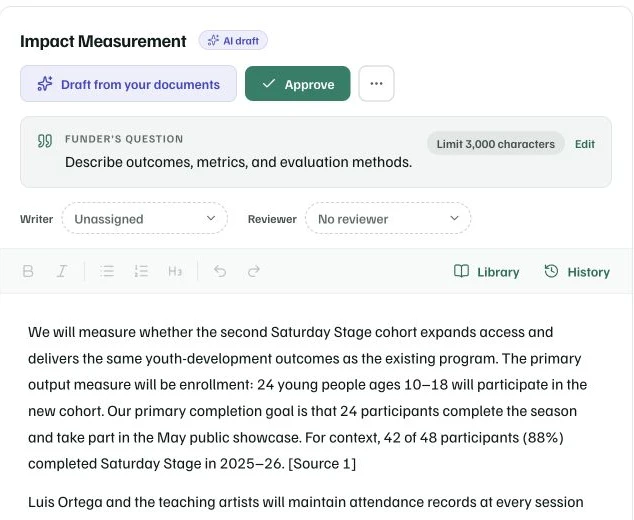 Enlarge
How does our existing work become a new answer?
Follow one fact from an impact report into the draft.
- Source material
- Lanternfield’s fictional impact summary records 42 of 48 participants completing the previous Saturday Stage season: 88%.
- Funder’s question
- “Describe outcomes, metrics, and evaluation methods.” The Impact Measurement section has a 3,000-character limit.
- AI-assisted draft
- The draft cites the past completion result, describes attendance and survey measures, and separates the new cohort’s goals from past results. The writer must review these commitments before approval.
The real editor is shown with a fictional theatre’s documents and an illustrative application. Prior results do not establish future outcomes; verify sources and edit every commitment.
Put it into practice
A complete example: source, draft, and human revision
AI-assisted grant writing starts with the actual question and evidence you can verify. The example below shows which facts support the answer, what is still unknown, and what a person must confirm before approving the response. All names, source excerpts, and drafts are fictional teaching material, not an actual AI run or a customer result.
1. Read the question and supporting facts
Illustrative funder question: “Describe outcomes, metrics, and evaluation methods.” Maximum: 3,000 characters. The response concerns Lanternfield Community Theatre’s proposed new Saturday Stage cohort.
| Fictional source | What it establishes |
|---|---|
| Prior-season attendance summary, results table | 48 registered participants; 42 completed. Completion means attending at least eight of ten sessions. 42 ÷ 48 = 87.5%, rounded to 88% in the short impact summary. |
| Reviewed project brief, delivery plan | The proposed next cohort has 24 places and ten planned sessions. These are plans, not past results. |
| Draft evaluation note | Attendance and a confidence survey are proposed measures. The completion target, survey timing, and reporting owner still need approval. |
| Evidence not supplied | No verified evidence of a long-term confidence change or proof that the program causes one. Do not turn a proposed measure into an impact claim. |
2. Prepare a draft and keep the gaps visible
This draft preserves the historical result and proposed cohort size, but it does not yet answer the evaluation question fully. The bracketed gaps are questions for the client, not language ready to submit. Actual AI output may omit a gap or include an unsupported claim, so check the whole response.
3. Verify the facts and approve the commitments
- The writer checks the attendance summary and adds the definition of completion and the exact 87.5% calculation. The new cohort’s target must be stated separately.
- Luis confirms a target of at least 20 of the 24 registered participants attending eight of ten sessions. He adds this to the fictional approved evaluation note; the writer does not infer it from the previous season.
- The same approved note assigns attendance records and first/final-session surveys to Luis, with Dana reviewing the report. It requires reporting survey response counts and describing confidence responses as self-reported feedback.
- The writer removes all placeholders, checks the 3,000-character limit, and asks the client to approve the final wording against the updated evaluation note.
4. Read the revised answer
The revised response stays under the illustrative 3,000-character limit. It identifies past evidence, a future target, measurement methods, and responsible people. Your application still needs its own sources, current funder instructions, and human approval before you submit.
How it works
From the funder’s question to a reviewed response.
Bring the requirements
Set up the funder’s questions and limits. Keep the project facts and documents you have permission to use close to the draft.
Draft, adapt, and edit
Draft from your documents, insert and adapt an answer-library entry, or rewrite a selection. Missing information needs your input.
Review and prepare the package
Assign a reviewer, resolve comments, check requirements and letters, and export the materials. You submit through the funder’s process.
Prepare the whole application, section by section.
Reuse your evidence and voice
Build an answer library from past proposals. Adapt approved material to the next funder, check old facts, and edit for your voice.
Explain the budget
Keep line items, your contribution, and donated resources in the budget. Prepare a budget explanation and reconcile it with the numbers.
Catch unfinished preparation
Review the proposal against its criteria, check the required documents and letters, then prepare Word, text, budget, or package exports.
What happens after signup
Start with a first look at your funding options.
01
Tell us about your work
Choose an organization, yourself, or clients you write for. Add your location, what you do, and what you want funded. Past support and documents are optional.
02
Review your first opportunities
Review setup and enable AI to start your eligible introductory research. Preview up to three sourced opportunities, check who can apply, and save a next step. No card required.
03
Choose the capacity you need
A paid subscription unlocks all research opportunities and new full reports. Daily research limits apply. Free includes 10 AI actions total; these do not renew.
Allow about 2 minutes for Quick search and about 30 minutes for a full research report. These are estimates, not guaranteed completion times. Introductory research runs after you review setup and enable AI; its completion time varies. You can leave a full report running and return later.
Compare plans and allowancesBefore you begin.
Do we need a dedicated grant writer?
No. The tools help with preparation and drafting. Someone on your team still verifies eligibility, program facts, the budget, and the final application.
Can I use past proposals without sounding generic?
Use material you have permission to provide. Draft around the new question and project, then edit the wording and verify reused facts. You keep control of the final voice.
Will it invent information we do not have?
Treat missing-fact flags and source references as review aids. AI can make mistakes; check claims against your documents, replace unsupported wording, and approve only what you can stand behind.
Can it submit or guarantee an award?
No. You submit the application and the funder makes the decision. Check the funder’s current rules on AI assistance before drafting.
Keep your next step moving.
Bring the work you have already done.
Start with your project and existing materials. Build a draft your team can review and make its own.
One introductory search · Preview up to three sourced opportunities · No card required. See paid plans